Posts

A Commoner’s Response to Colorado Governor Jared Polis’s recent State of the State address

“Optimism…is the obstinacy of maintaining that everything is best when it is worst.” (Voltaire, Candide)

You, Governor Polis, are fond of saying you’ve worked ceaselessly “to create jobs and save the people of this state money.”

The question is, does this statement hold any water when weighed against the climate crisis that besets the world, as the Los Angeles fires once again remind us? In terms of intensity and speed, the LA fire, already called the most expensive in this nation’s history, is eerily reminiscent of the Marshall fire just north of Denver in Boulder County, only a couple of years back. Though it certainly doesn’t diminish personal loss and devastation in the individual case, the LA fire is vastly larger in terms of duration and scope, with 28 people already reported dead, well over 130,000 people told to evacuate, and over 15,000 structures damaged or destroyed, exposing once again society’s immediate and growing long-term vulnerability to a changing and dangerously unpredictable climate.

Ever the vainglorious braggart Il Capitano of Commedia dell’Arte, President elect Donald Trump has declared that had he been California’s governor the LA fire would not have happened. He made a similar pronouncement during the late world pandemic, when he proclaimed, Il Duce-like, with jutted jaw, that the coronavirus would never dare cross our borders. He became very ill with the virus, but unlike the many who died, he received the country’s best medical attention to aid in his recovery. He is also a climate denier, proclaiming it a hoax.

But, enough of stock characters in early Italian comedy and their modern day counterparts in American politics. The central question we must address and resolve, Governor, is your meme- like claim that you are saving us jobs and money. The following are but a few of the things we must consider when judging whether your easy optimism is sane and just or just bunkum.

Since 2019, when you were sworn in as Governor, your administration has approved over 7700 new oil well proposals. Fewer than a hand full have ever been denied, and those denials were generally made by your appointed state regulators on technical or jurisdictional grounds, not because they were judged to pose a threat to public health and wellbeing or the natural environment.

Remember, too, it was you Governor who said in signing the 2019 Oil and Gas Reform Act into law, as one of your first official acts, that it represented a “sea change” in the way oil and gas activities would henceforth be evaluated and regulated in this state. (This law, which has boundless public support, is better known to many as SB 181.) This reform act promised, without equivocation or exception, to change the state’s long-standing policy of encouraging oil and gas development to a policy of only permitting new or continuing oil drilling and production provided it could be demonstrated that such development did not pose a substantial threat to public wellbeing or the environment, which of course, as any 3rd grader knows, includes the earth’s climate—one of the few things, like birth and death, we still all share commonly.

According to state records, your administration, working ceaselessly I would argue, has overseen and approved production of 2.9 billion barrels of oil or oil equivalent since 2019. And according to you, this massive production of fossil fuels has been done with no substantial injury to the people or the environment. This has been accomplished, say you, because of your belief in a market- based economy, which, in its turn, has helped create a climate of goodwill and cooperation between your administration and the oil industry. As a result, we are told, you and the oil industry have been able to develop and adopt the strongest oil and gas regulations in the nation, if not todo el mundo.

Well, maybe not Governor, for if we convert this fossil fuel production to the amount of atmospheric loading of CO2 resulting from its use in the marketplace or on the battlefield, we come up with nearly one billion tons of atmospheric loading.

But that’s not all. If we add in the amount of methane leaked from oil and gas operations in this state since 2019, we arrive at a rough doubling of CO2 for a grand total of over two billion tons of atmospheric loading, a simply staggering number.

While it’s true the volume of methane leaked is but a fraction of overall fossil fuel production, methane’s 86 times greater atmospheric heat-storing capacity makes it oil production’s climate destroying equal over the short term of 10 to 20 years. This important distinction is why scientists say that while both CO2 and methane emissions must be controlled and reduced, it is methane reduction which has the greatest short-term impact on climate and should therefore be our first focus if we are to save ourselves and the planet. It perhaps goes without saying, Governor, that the best way to reduce methane is to not produce more of it.

The methane leak rate used here is derived from actual, though intermittent, satellite measurements. They indicate the leak rate is 1.7 percent of production Your office says the leak rate is only 0.6 percent. This may be, once again, because your administration has developed the best regulations in the world, but it may also be because you rely heavily on the oil industry to tell you how much methane it is leaking into the atmosphere. To this commoner, reliance on industry reporting to measure public and environmental outcomes is a little like having Bernie Madoff do your personal financial planning. Could you really trust him?

Governor, as you undoubtedly know, this reliability issue is being addressed by independent field observers like Earth Works. They do actual field measurements using sophisticated gas- identifying FLIR cameras. In 2023 they found methane leaks at 29 of the 77 well sites inspected. None of these leaks were reported by the industry in its annual leak report to the state. It is these industry reports that form the basis for the state’s Bower of Bliss 0.6 methane leak rate. To this commoner it looks like a true 100 percent error rate, and suggests flat dishonesty or duplicity in the state’s good-news reporting to the people. The fact that independent studies in other oil producing states project leak rates of between 4 and 8 percent strengthens that perception.

Governor, the real question now becomes what are the societal costs of loading CO2 into the earth’s atmosphere? A new study published in The National Bureau of Economic Research places the social cost of CO2 loading at a slobber knocking $1065 per ton.

Thus we can reasonably say, as shown in the table below, that your administration has caused or helped cause $2.6 trillion in social costs or damages through its continuing, unrestrained protection of oil and gas production in this state. These are of course societal costs borne by every person and creature in every nation of the earth; nevertheless, the final accounting is much greater still, since the calculations look only at physical damages. Not included are the human deaths or species diminishment and extinction caused either directly or indirectly by your embrace of the oil industry.

Table showing Colorado Oil and Gas Production Causes Vast Economic Damage
Year2019 2020 2021 2022 20232024 (partial year)Total 2019 – July 2024
Oil and gas produced (million barrels) 15165625225235282452896
CO2 emitted
(million tons) 2
179195182182184851007
Methane CO2 equivalent 1.7% leak rate and methane 20-year warming factor of 86(million tons) 32622862662662691251473
Social Cost of Carbon at $1065 per ton CO2
(billion $) 4
$471$512$476$477$482$223$2,641

Prepared by Wes Wilson and Barbara Mills-Bria, BE THE CHANGE -COLORADO, September 5, 2024, for Colorado Energy and Carbon Management Commission, Cumulative Impact Rule Making.

1. Colorado Energy Office, GHG Pollution Reduction Roadmap 2.0, February 2024, https://energyoffice.colorado.gov/climate- energy/ghg-pollution-reduction-roadmap-20
2. Rick Heede, Climate Accountability Institute, Climate Mitigation Services, Oil Emissions Factor Calculation, Snowmass, CO, June 2013 republished, https://climateaccountability.org/wp-content/uploads/2023/10/Oil-EmissionFactorCalc-6p.pdf
3. Environmental Defense Fund, MethaneSAT, New Data Show U.S. Oil and Gas Methane Emissions Over Four Times Higher than EPA Estimates, https://www.methanesat.org/project-updates/new-data-show-us-oil-and-gas-methane-emissions-over-four-times-higher-epa-estimates. EDF reported leak rate for Colorado’s Denver Julesburg Basin. The amount of CO2 equivalent based on the methane global warming potential of 86 times CO2 over a 20-year period.
4. The Macroeconomic Impact of Climate Change: Global vs. Local Temperature, Adrien Bilal and Diego R. Känzig, Working Paper, National Bureau of Economic Research, revised August 2024, https://www.nber.org/papers/w32450

For the lovers of market wisdom as the road to enlightenment and wise decision making, a recent report from the Energy Information Administration, EIA, may shake that faith. It reports that the market value of Colorado’s total oil and gas production in 2023 came to about $17.4 billion. Of course, much of the profit from this production went to CEOs and rich investors, many living in other states or nations. The social costs of this production in 2023 was about $480 billion as shown in the table above. Thus, we can say that from a market standpoint the negative climate impacts exceed the market value of the product by a ratio 28 to 1.

Governor, you’ve said in the past that you thought the market would decide the oil issues in this state. That was and is a cryptic statement for a commoner like me, but still, the market seems to have spoken. Why is no one listening while your administration leads us down the road to serfdom and worse?

The one thing that can be said with certainty is that the requirements of the Oil and Gas Reform Act, which you signed into law, have been scattered to the four winds, and as a result, you have neither protected the people nor the environment from substantial harm. Oddly, Governor, the many cities, like your hometown of Boulder, that are suing the oil industry for climate damages might rightfully add your administration to their suit, thus creating the even greater oddity that they would be suing themselves and us commoners as well.

The authors of this new study on climate are Harvard and Northwestern university economists. The Harvard economist has stated that if global average temperatures rise 2 degrees Centigrade above preindustrial averages the world’s economy would be reduced by half.

Now to be sure, Governor, the average world temperature increase has not reached 2 degrees C, but, as you know, last year it did reach a 1.5 degree C average increase for the first time ever. Scientists have long held we must stay below that ceiling if we are not to unleash destructive forces way beyond the control of puny mortals. Red alert Governor, the IPCC says that if we don’t significantly reduce emissions the 2 degrees C threshold could be reached within the decade. Scientist have also long held that if we get to 2 degrees all bets are off, Milton’s Chaos and Old Night will become each person’s personal Netflix.

So here’s where it starts to get really ugly, Governor. Many informed people, not just scientists, are saying because governments are unwilling to control fossil fuel production and its unavoidable pollution we, the people, will suffer the whirlwind. Indeed, given the moral collapse of governments in the face of industry wealth and power, even keeping to a 2 degree C increase as the IPCC warns is very, very unlikely. You may well ask, Governor, what the employment picture in Colorado would look like if we pushed to 2 degrees C, or even beyond?

According to a 2023 study by the Colorado Fiscal Institute, another study your administration seems to willfully ignore, the oil jobs in this state are relatively unimportant to the state’s economy. The industry accounts for only 1.8% of total wages in the state and an even smaller 0.7 percent of total employment.

Governor, if we reach the unthinkable, and achieve a 2 degree C increase, you can not only kiss the 20,000 oil and gas jobs goodbye, but half of the 2.7 million other jobs in the state would disappear with them. Could organized society survive Governor? Maybe, but I think many of us commoners would start to experience the dehumanizing privations visited upon the people of Gaza. In fact, we might find ourselves close to realizing our natural state, which the English political philosopher Thomas Hobbs once described as: poor solitary, nasty brutish and short. Governor, your claim of saving us jobs, like your claim you are saving us money, just doesn’t hold water.

If more evidence is needed in defense of this conclusion, studies show that rapidly spreading fires like those in Los Angeles and Marshall, right here at home, have increased by 250 percent over the past 20 years. Other analysts suggest that nationwide 1 in 5 homes are already in danger of fire or flood.

The continuing health impacts of oil and gas production in this state, while not strictly speaking, job and money issues, are also morally confounding, especially since protection of public health and wellbeing are specific requirements of the Oil and Gas Reform Act. For example, a recent citizen directed study of pollution from the Suncor oil refinery, located in the heart of Denver, indicates small particulates, PM 2.5 exceed the new federal health standard of 9 ug/l all of the time in the Suncor and surrounding neighborhoods. In fact, they exceeded those standards by 60 percent on average. Health organizations attribute 8 to 9 million deaths worldwide to PM 2.5 annually. Governor, it‘s not overreach to suggest some portion, no matter how small, of the PM 2.5 mortality rests on your doorstep. That same study found frequent peaks of other pollutants such as benzene and radioactive particles that exceed health risk criteria coming from the refinery.

EPA’s regional office, clearly understanding the health risks the refinery poses, has rejected your administration’s attempts to get new pollution permits approved for the refinery under the Clean Air Act. With the dangerous buffoon Donald Trump, Il Capitano, in office, you will find an openly willing ally in oil industry subservience.

And of course there is the Denver region’s terrible air quality, especially its ozone pollution, which has exceeded federal standards for well over a decade. Methane, as even the state admits, is chief culprit in the creation of this problem. Your claim that your new super-duper rules have reduced methane releases to 0.6 of production allows you, not accidentally I think, to pin the tail on the wrong donkey. You’ve convinced the public it’s their fault for driving too much and using gas lawn mowers. I think we don’t have to dwell long upon this blaming the victim fiction. Oil and gas production and its resulting methane releases locally are the major source of our ozone problem, and only its reduction will result in the clean air results we need, want, and were promised by a state law you signed almost 6 years ago.

And just so no one can accuse me of ignoring the many other good things you’ve done for the people with regard to oil and gas development in this state, I’d like to pivot briefly to bonding, or how the oil and gas industry insures itself against being unable to close all the wells in its ownerships once those wells run dry. One of the purposes of the Oil and Gas Reform Act was to ensure that bonding was adequate so that the financial burden of closing these played out wells did not become the public’s.

This is somewhat of an aside, but the proposed rules for bonding were under review a couple of years back. I, as part of a small grassroots group, argued that there should be full cash bonding for every well in an ownership. That a trust should be established with this money and any interest earned dedicated to the long-term maintenance of those wells after the oil industry had left the state for greener pastures–say Greenland after the ice sheet melts.

This proposal was ridiculed by Mr. William Gonzalez, a lawyer and landsman for Occidental who’d taken a leave of absence to serve on your commission at a salary of $150 thousand annually. He said the oil industry had better things to do with its money. He apparently thought we commoners didn’t. His position won of course. He resigned and went back to work for Occidental with a nice promotion.

Governor, the last time I saw Mr. Gonzalez, a couple of weeks ago, he was chairing your Air Quality Control Commission. This commission, made up of your appointees, is responsible for the development of air pollution guidelines in the state, including oil and gas pollution regulations; yet, it refuses to implement the clear requirements in the Oil and Gas Reform Act that the public and environmental protection test must be met in every oil and gas permitting case. Governor, it is state law. Thus in this commoner’s opinion, It applies equally to all state activities relating to oil and gas production or it becomes merely Swiss cheese, worthless for everything save sandwiches.

For several years I engaged in a back and forth conversation with this commission over why it was refusing to use the Oil and Gas Reform Act’s clear public and environmental protection requirements as the basis for approving or disapproving oil and gas pollution permits, the approval of which, I might add, makes up a substantial part of its operating budget. They finally tired of my questions and told me it was none of my business.

Governor, a month or so ago Carbon Tracker came out with an analysis showing
the minimum cost for closing all existing wells in the state is $6.8 billion. They also calculate that your administration has only about $218 million in bonding on hand to remediate and close an inventory of roughly 47,000 open wells, and another 13,000 wells that have been closed but remain uninspected for adequacy of closure.

Carbon Tracker goes on to say, given the sieve-like nature of the state’s bonding regulations, that the best the state can ever expect to recover from the industry is about $456 million. Governor, that leaves us commoners on the hook for $6.4 billion in cleanup costs, and that’s if there are no cost overruns and no new wells—both truly head-in-the-sand assumptions.

While the bonding shortfall is only a fraction of the trillions of dollars in social damages this state has gifted the world, it is very doubtful we can gull someone else into to paying our well cleanup costs. That $6.4 billion bill will not be carried by the wind to far away places. It will be ours to pay.

Governor, I think the foregoing rules out any serious comparison of your optimism with Candide’s. Candide, the titular hero of Voltaire’s satire, foolishly persists in his belief that this is the best of all possible worlds, even as events such as war, disease, earthquakes, and mistreatment at the hands of ruling class nobility make his life a relentless series of torments and misfortunes.

Governor, you’re not delusional like the haplessly foolish Candide. Neither are you like Il Dottore, another stock character in Commedia dell’Arte who knows everything, but understands nothing. There is something much more sinister going on here, for your manufactured optimism is a carefully constructed deception in service of the corporate world, particularly the oil industry which in this state always has held the upper hand. The clear result is your administration has created the fiction that oil and gas production can be made good provided it is guided by the leading edge management expertise your administration provides. The combined efforts of the ruling class and the very rich working together can create, as you so often remind us, the best of all possible worlds.

The economist Nancy Frasier says this alliance of the ruling class, of which you are a member, and the super rich, of which you are also a member, is an effort to make sure government serves only the narrow interests of wealth and power. This framing, Governor, is of course all at the expense of the rest of us, making it the best of all possible worlds for the few, and worst of all possible worlds for the many, the commoners. She calls it Cannibal Capitalism. I call it “we eat our own.”

Note: the foregoing information on the cumulative climate impacts of oil and gas production in Colorado was presented to the state’s Energy and Carbon Management Commission in a more detailed 20-minute presentation in September of last year. The Commission is composed of 3 attorneys, 2 of them oil and gas attorneys, a wildlife biologist, and a former county commissioner. Each draws a public salary of between $150 thousand to $160 thousand, plus benefits. They asked not one question following the presentation, neither have they ever asked for or sought clarification on any of the information we presented. We made the presentation as a “party” to a proposed rulemaking on how to do cumulative impact evaluations of oil and gas production in the state. Cumulative impact evaluations are required by the state’s Oil and Gas Reform Act, an act Governor Polis signed into law almost 6 years ago.

Ever disdainful, Colorado’s Suncor refinery is at it again, polluting to high heaven

Did you catch the big Colorado news flash?   Denver’s century-old Suncor refinery got fined again–this time a reported $10 million for continuing its poisoning of the people. 

The fine, issued by the state, gives the illusion of corrective action, but it is only an illusion.  It will not save one child from developing asthma, or, even worse, developing cancer.  It won’t save one person with heart or lung problems from worsening complications, or dying prematurely.   And it won’t change the air quality for the thousands upon thousands of people who are Suncor’s next-door neighbors and victims.  

What this fine truly represents is a form of payola that is ongoing and deeply deceptive.  It works like this.  Suncor pays a $10 million fine, but 80 percent of it is forgiven and returned to Suncor.  So, it’s really only a $2.5 million fine.  Why then does the state pat itself on the back for what is basically a headline stealing lie?  

The reason, quite frankly, is that it leaves the impression with the casual observer of rectitude and corrective action.  Yet, the fine in no way requires Suncor to straighten up and fly right.  And what is more, why should the lion’s share of the fine, which is really taxpayer money, be returned to Suncor so that it can install a new generator to prevent its frequent cold-weather breakdowns?  Yes, according to the settlement, the state gave the money back to Suncor so it could upgrade its equipment.  

Should the public have to pay Suncor’s maintenance and operating costs?  After all, it is the second largest corporation in Canada, with gross revenues in 2022 of $27 billion.  Clearly, Suncor is not a mom-and-pop grocery store selling an underage kid a six-pack of Bud.  Mom and pop might get a break if they weren’t habitual underage sellers, but why should Suncor?  It’s a big-time habitual abuser. 

If you were to receive a ticket for driving impaired, along with a $600 fine, you would almost certainly have to go to drunk-driving school as well as pay the fine.  Try asking the state to return most of that $600 to offset lost time and expenses required to attend driving class?  Even a Pollyanna might blush at the foolishness of such a request.   Indeed, it’s a certainty that if you continued to drive drunk, and were caught, you’d soon lose your license and go to jail. 

Suncor’s record of killing its neighbors, if ever so slowly, is the equivalent of the habitual drunk driver, except in its case it doesn’t go to jail; it’s not the victim of a debilitating disease, unless, of course, you consider greed and disdain diseases rather than pathologies; and most of the tinselly fine money is returned to it’s corporate sock drawer for rainy-day spending. 

In fact, just 5 years ago Suncor was fined $9 million, again for poisoning the people.  Here again $5 million of the fine went back to Suncor to hire a consultant to find out why its operations were so filthy.  Events confirm the $5 million was wasted–or may still be in the sock drawer.  

We know this because about $1.8 million of that earlier $9 million fine went to a small, community-based Latina citizen group called Cultivando.  Cultivando, with the help of other sympathetic citizens, used the money to continuously monitor the releases of toxins from the refinery.  (Admission, I was on their advisory board.)  What they found was a full-time abuser.  For example, they found that soot, what air-quality people call PM 2.5, exceeded federal regulatory clean air standards all the time.  Spikes in this pollutant were measured as high as 1700 micrograms per cubic meter (ug/m3.)   In fact, the federal Clean Air Act  (CAA) 24-hour standard for PM 2.5 of 35 ug/m3) was exceeded about 14,820 times over six months of monitoring, including two winter months when the refinery was supposedly shut down for “major” repairs.    PM 2.5 is estimated to annually kill 8 to 9 million worldwide.  It is not overly speculative to conclude a few of those millions live in the Suncor neighborhoods. 

A chemical cocktail of other toxins was also recorded during this six-month period.  The following is a pared down list:  benzene, with a .9 parts per billion (ppb) health threshold was exceeded 316 times; hydrogen sulfide, with a 8 ppb threshold was exceeded 3,895 times; hydrogen cyanide, with a 2.7 ppb threshold was exceeded 24 times; and nitrous oxides, with a 53 ppb threshold were exceeded a whopping 65,203 times.  Radioactive particulates, the measurements of which may be a national first for a refinery, also exceeded the health threshold of 1 pc/L 18 times. 

In the past, Suncor has released sun-blotting clouds of sulfur dioxide (SO2).  A release in 2016 caused an interstate highway to be closed down, with local school children told to shelter in place.   This event was repeated in 2019 when orange clouds of SO2 and clay like particles called catalysts rained down on a defenseless population.  

Cultivando’s monitoring equipment recorded two similar events in April of 2022.   Suncor failed to report the first of these, as is required of it under its operating permit.  That event may have resulted in the CAA one-hour standard of 75 ppb for SO2 being exceeded roughly 5030 times over.  The event was repeated a couple of weeks later.  Suncor, as is its habit, claimed there was no danger.  The state offered hesitant agreement.  These denials of any danger might lead one to question why any standards should exist if when exceeded no danger to the public results? 

More broadly, the state’s regulatory agency, the Air Pollution Control Division (APCD), has given a rather muffled response to the findings in Cultivando’s air monitoring of Suncor.  The state talks often about forcing Suncor to meet the release limits required of it in its pollution permits.  Generally, these permits tend to be quite liberal since they are based on what is engineering or economically possible for the polluter rather than on strict health protecting considerations.  In other words, they are corporate first considerations. 

The APCD also asserts, despite Suncor’s myriad short-term permit violations, that the refinery remains in compliance with the federal standards as set forth in the Clean Air Act.  These standards cover only 6 pollutants, however, and are based primarily on daily or annual averages.  As a result, the spikes in pollution as measured and recorded by Culitvando’s monitoring are subsumed and become unidentifiable in the process of averaging.   

Many other pollutants beside the 6 with standards are, of course, listed as hazardous by EPA, but no firm ambient air-quality standards have been set for them.  Many reasons can be found for the regulatory slovenliness, but the power of the oil industry to frustrate enlarged federal oversight is surely chief among them. 

Still, even the claim that Suncor meets the CAA standards, and therefore the state’s hands are effectively tied, is highly questionable.  Cultivando’s monitoring indicate that not only is the 24-hour small particle, PM 2.5, standard exceeded as discussed earlier, but so is the average annual.  The average annual PM 2.5 release as calculated from the citizen monitoring is 14.5 ug/m3.  Thus, EPA’s spanking new CAA standard for these small particulates of 9 ug/m3 was exceeded by over 60 percent on average.  Even the old standard of 12 ug/m3 was exceeded by almost 20 percent. 

The state has shown no inclination to act on this damning information, even though it accepts the scientific integrity of the monitoring program itself.  Unfortunately, the new standard, which should be even harder to ignore, will not go into effect for at least another 3 years as the polluting industries are given time to adjust.  The people will be asked to endure, once again.  Equally important the 4,500 premature deaths EPA estimates would be canceled out by this rule as well as health benefits of up to $46 billion will have to wait for the Suncors of the world to straighten up and fly right.

By comparison, California’s Bay area regulators are not waiting for the future.  On the heels of a court-settled $20 million fine, it told the East Bay’s massive Chevron refinery that it would also have to reduce its small particulate releases by 80 percent by 2026.  If it doesn’t, it will be subject to annual fines of $17 million, rising to 32 million in 3 years.  The required retrofit may cost $1 billion.

John Cioia, the county supervisor representing Richmond, said of this ruling, “This is one battle, but the war is not over.”   Most Coloradoans would suspect the miracle of midnight religious conversion if a Colorado regulator or the governor, in particular, issued such a straight-forward declaration.  Polis like his predecessor, John Hickenlooper, now a U.S. senator (D), is a hands-off type of guy when it comes to corporate regulation.  Corporate friendship rather than citizen protecting, but friendship threatening, regulation is their mantra. 

Perhaps the greatest disappointment for the citizens conducting the Suncor monitoring program is the state’s reluctance to examine the effect massive spikes in various toxins, shown to occur over and over again, has on people over time.  It really comes down to a question of whether it’s safer to put your head in an old gas oven for a year with an average low release rate, or to do it many times intermittently over a year on those occasions when release rates are high.    The state’s position is that only if you put your head in the oven for a year is there damage.  Both kill you, so why hide behind a distinction without much meaning in terms of human health? 

The state also refuses to look at the multiplying or synergistic impact of people inhaling these toxins in combination.  The Cultivando study indicates that often when one toxin is spiking others toxins are also present at heightened levels in the air. As a for instance, when PM 2.5 is spiking off the page in the Suncor neighborhoods, it is very likely other toxins such as benzene and radioactive particles are also spiking.  

The two health professionals, enlisted by Cultivando to help with the health evaluation of the Suncor monitoring results, think that in many cases mixing of toxins in the air people breath has a negative multiplying effect from a human health perspective.  (Both of these professionals, Wilma Subra and Dr. David Brown, have national reputations.)  The state is unwilling to recognize the science of multipliers, even though it appears to be a well-established principle within the field of toxicology. 

I asked Dr. Brown recently if he would live in one of the Suncor neighborhoods.  An octogenarian, he is a deliberate man, wise with the wisdom of age, not prone to enthusiasms.  He looked at me for a moment and said, “Well Phil, there is one thing I can tell you, if I had a pregnant daughter I sure as hell wouldn’t let her live there.”

COGCC has approved 248 drilling permits since SB181 was signed – without any rules in place

Since SB 181 was signed into law on April 16, 248 drilling permits have been approved by the COGCC. These permits were approved even though no rules have been implemented to protect the health and safety of Coloradans who live in these areas. Instead, Jeff Robbins, the director of COGCC, drafted a framework of “15 Objective Criteria” to determine which wells can be approved without jeopardizing the health of nearby residents. These criteria are not based on scientific studies but instead on a very subjective set of guidelines designed to keep the oil and gas industry happy and in business.  This streamlined process sidesteps the intent and letter of SB181, adding a veneer of legitimacy to an end-run around the rule making process.

Statement by Be the Change Before the COGCC, Series 500 Rulemaking, June 17, 2019

The course of action being proposed in this rulemaking is illegal.  We have said this repeatedly and without hesitation from the day Director Robbins introduced his so-called “15 objective criteria.”  That was roughly a month ago.  We say it again today, hoping someone on this new commission will take notice.

His criteria are hardly objective.  They are in our judgment simply arbitrary and capricious.

The signal feature of Mr. Robbins “15 objective criteria” is a 1500-foot setback from homes in municipal settings.  He is silent on what rural people deserve in terms of protection.  Indeed the 1500 feet is not really a setback, but a threshold requiring further review by his office.  Apparently, any drilling proposal that is greater than 1500 feet from an urban dwelling is deemed safe.  These criteria are to rule oil and gas permitting procedures until real rules can be developed for SB 19-181.  Mr. Robbins says this may take 2 years or more.

We invite your attention to the declaration of intent in SB 19-181, which became the law of this state two months ago on April 16.  The legislature directed state government to “regulate the development of the natural resources of oil and gas in the state of Colorado in a manner that protects public health, safety, and welfare, including protection of the environment and wildlife resources;” p 9-10.

Mr. Robbins cannot demonstrate his 15 criteria comport with this foundational requirement of the law.  Neither can he demonstrate his criteria are consistent with the state’s Administrative Procedure Act which says that for any rule to be valid it must not conflict with other provisions of the law.  The conflicts are various and far reaching as we shall demonstrate.

In our judgment, the following are the subjects that must be addressed through rulemaking before new drilling and supporting infrastructure can be built. We have listed them in order of their importance–from our perspective.  All of them are essential to understanding the impacts of oil and gas on the public’s welfare and the environment.  All of them must be integrated into the regulations that guide the activities of the COGCC and the CDPHE.  The CDPHE has essential and serious responsibilities under the new law.  Director Ryan, it is our judgment these responsibilities have simply been ignored up to this point.

In order of their importance we list:

  1. Setbacks
  2. Cumulative impact analyzes
    • Air
    • Land
    • Water
  3. Bonding
  4. Financial Assurance

We would remind you that though the legislature did not address climate collapse directly in this legislation, we believe it is implicit to the purposes of the law, since the public’s welfare cannot be protected unless we recognize climate protection as essential to our continued existence.

Setbacks

We’ll start off here with several photos of oil and gas explosions.   They are intended to provide context for a discussion of setbacks.

Even a quick look will dispel any doubt that this is a feather floating across the landscape.  No, it is a 20,000-gallon (estimated) frack waste storage tank exploding off its foundation.  If filled with liquid it would weigh about the same as a small steam locomotive, about the size of the Hogwarts Express.  All those present who would like to live within 1500 feet of such a floating behemoth please raise their hand.

Windsor fire at an Extraction drill site northeast of the town

This photo is of the Windsor fire at an Extraction drill site northeast of the town.  There was apparently an uncontrolled gas leak throughout the day.  The gas finally ignited.   A spike in benzene was measured in Boulder County, 40 miles away at the state’s only continuous air monitoring site.  One can only imagine what the benzene concentrations were in and around Windsor.  Benzene is a carcinogen.  It is ubiquitous in oil and gas production.  It is unsafe for humans at any concentration.

Reportedly, eight fire departments were involved in extinguishing the fire.  The local fire marshal established a fire line or setback one-mile distant from the well site.  The fire fighters used all the fire suppressing foam available in northern Colorado to extinguish the fire.  This foam, called AFFF, is also a carcinogen responsible for large-scale ground water contamination in the United States.  The groundwater contamination in Fountain, Colorado, is a close-to-home example.

This is a picture of another explosion at a drill site in Oklahoma.  Five workers were killed, one a Coloradan.  The fire was so intense that firefighters couldn’t get near enough to extinguish it for over a week.  Here again the fire line was one mile.

Obviously 1500 feet is not supportable as protective of public health and safety.  We are not suggesting attribution, but we do note that 1500 feet was a compromise position developed for the industry by RS Energy last year in the battle over Prop 112, which, as you know, called for a 2500-foot setback.   At 1500 feet the impacts on the industry’s core holdings would be minimal according to the industry study.  Even Extraction, whose business model is based on urban drilling, sometimes within shouting distance of little Dick and Jane’s swing set, would have been only moderately impacted.

Mr. Robbins may not have pulled his 1500-foot setback “criteria” from a hat.  He may have devised it to minimize the impacts to the oil industry.  But that is the wrong answer to the wrong question.  The question is no longer how do we minimize regulatory impacts on oil and gas development in this state, but how do we protect the public?  What setbacks are required to do that?

We don’t have a hard answer to this question.  But statistical studies have been conducted by the Colorado School of Public Health (CSPH) which suggest 2500 feet may be a reasonable minimum.  Researcher Lisa McKenzie and her colleagues at Anschutz state that air pollutants from oil and gas operations “are potentially a major health risk for nearby populations.”  The study showed an increase in the incidence of cancers occurred within 2500 feet of these facilities.  Other studies from Anschutz researchers show increased incidence of childhood leukemia in a residential setting up to a mile away from drill sites.

Governor Polis might have been right when he said one size does not fit all.   In fact, it appears 2500 feet might be the reasonable and necessary minimum setback, but topography and prevailing wind patterns at a proposed oil facility could cause the safe setback to be lengthened dramatically using the precautionary principle as guide.

Remember it was Senator Foote, one of the sponsors of the SB 19-181, who emphasized on the floor of the senate that it was the precautionary principle that should guide decisions in this rulemaking.  So, unless the industry clearly demonstrates public safety can be maintained at a distance less than 2500 feet, as a minimum, the science that exists must stand as guide.

Cumulative impacts

We note that the law, on p.19, directs the CDPHE to participate in developing these important data sets that are essential to health, safety, and environmental impact evaluations.

Water: The volume of fresh water needed for fracking is alarming.  For example, if all of the roughly 6500 drilling permits received by the COGCC in 2018 were to be approved, and all were for horizontal wells, the total water demand might be about 65 billion gallons.  That is more than the treated water than Denver Water supplies to its customers annually.  It is in fact, over twice the amount since over half of the domestic water demand gets back into the hydrologic system to be used again and again downstream.  From a cumulative impact standpoint, we should want to know how much water will be needed annually for fracking over the next 10 years, and whether that demand is sustainable.  The base condition for this analysis should be the estimated amount of water the industry has used by year since 2008, the advent of the fracking invasion.

A recent study at Duke University shows that from “2011 to 2016, the water use per well increased up to 770%, while flowback and produced water volumes generated within the first year of production increased up to 1440%,” and this was across all regions.  Their conclusion is that the volume of water and liquid toxic waste will only increase in the coming years.   It’s time we started treating fracking’s cumulative impacts with the seriousness they deserve, and with the diligence the new law demands.  The seat-of –the-pants approach, where we basically rely on the industry for all important information, must be abandoned.

With regard to the water sustainability issue, the impact of diminished surface supplies predicted from the climate crisis should also be examined using sensitivity analysis since we are unsure of the exact snowpack and runoff reductions we can expect from a hotter and drier climate in the southern Rockies.

This sort of analysis becomes even more important in light of the efforts to get the taxpayers to underwrite billions of dollars in new projects for water that is not likely to exist in the future with even moderate climate change.  Some of this water, we read, is earmarked for fracking.

A thorough review of the Class II injection well process needs to be undertaken, as well.  That injection process was implemented in the early 1980s and hasn’t undergone any serious review since, even though the original purpose of the program was to allow old played out vertical wells, designated Class II wells, to be reinjected with liquid waste from nearby producing wells to increase underground pressure and thereby stimulate production at the nearby producing well.  It is now used to dispose of almost all liquid toxic waste from fracking activities.

Here again the baseline condition should be the amount of toxic liquids the industry has pumped annually into Class II wells since 2008.  Using a 10 -year planning horizon, how much toxic liquid will be generated for disposal?  Is the present Class II system adequate to handle this volume, or will new wells be required?  We know that some Class II wells have been approved for injection into potable water supplies, primarily because those supplies were thought to be too far from demand to ever be tapped for domestic or industrial use.  Given the realities of climate change should this program be terminated?  From a sustained use standpoint, better tracking of the original estimated capacity of these Class II reservoirs, the approved injection rate, and remaining life expectancy need to be developed and analyzed for their cumulative effects.   For example, how many new disposal wells might be needed under a range of reasonable projected disposal requirements?  What are likely to be the local and regional impacts if new wells are required?  Clearly, the list could go on, but this kind of data is necessary in any adequate cumulative impact evaluation on fresh water use and toxic liquid disposal.

AIR: A monitoring system that is continuous across the oil patch, upstream and midstream, is necessary.   This technology exists and must be employed.  Our air quality is so compromised, much of it from oil and gas activity, that nothing less is morally acceptable, and SB 19-181, to be effective, demands it.

Continuous system measurements must be immediately available to state and local governments, free of massage or filtering by the industry.  In other words, it must be state run and verifiable by local and regional oversight.  Recent articles in the Colorado Independent and the Denver Post simply underscore why such a system is nonnegotiable—public trust must be restored.   A recent letter from WildEarth Guardians to Governor Polis, dated April 23, 2019, exposes the general lawlessness that exists within the state’s regulatory system, particularly with regard to the federal Clean Air Act.  Specifically, the state has allowing the oil and gas industry to operate for 90 days or longer without the required clean air permits.  As a result, VOCs and poisonous gasses such as benzene have been released without restriction or measurement.

VOCs are a major contributor to the northern Front Range’s ozone problem.  Denver, as a result, has been judged to have the 12th worst air quality of any city in the country, sometimes beating out Beijing, China, for the honor of really bad.  NOAA measurements indicate an estimated 55 percent of the VOCs, above background, come from fossil fuel operations in the Front Range, primarily Weld County.

Unfortunately, the monetary and social impacts of ozone pollution are mostly available only on a macro scale.  The CDC, in 1980, well before the fracking invasion, estimated asthma, for which ozone pollution is a major cause, costs the U.S. economy about $80 billion annually in sickness and lost work.  We are obviously more than paying our fair share.

A more recent study by the Office of Economic Co-operation and Development (OECD) concludes premature deaths from ozone pollution have dramatically and continuously increased over the last decade and a half.  Overall, they conclude that air pollution in 2015 was responsible for 3.2 million premature deaths globally and cost the world economy $5.1 trillion.

The World Health Organization has said air pollution is the “worlds single largest health risk.”  This assessment excludes climate collapse, of course, for it is not just a health risk, but an existential risk.  A few may perceive from this discussion that a rapid conversion to renewables and a quickening denial of all new fossil fuel development might save our bacon.

Given the above, and to be effective and have public acceptance, the monitoring system mandated by the law must incorporate the following:

  • It must be continuous and independent of industry manipulation.
  • It must be verifiable to preclude tampering.
  • It must delineate the various chemicals being released.  This capability is essential from a health perspective, for one cannot simultaneously measure the human health effects of oil development’s point source methane (a nontoxic) and benzene (a proximate toxic) contributions with the same probe.
  • Those who talk of VOCs will be looking mainly to the longer term human effects of ozone, thus to dispersing, aging plumes. Such plume emphasis will neglect the proximate toxicity of point sources of benzene because its concentrations cannot be accurately captured by plume sampling, continuous or otherwise. To accurately assess the overall health effects of oil production‘s point source pollutions, two separate probing techniques will be necessary—one for ozone and one for proximate benzene exposures as their atmospheric behaviors are significantly different.
  • It should be compatible and useful to recent legislation dealing with better measurement of green house gas emissions, and the move toward renewables.  See SB 19-096 and HB 19-1261.   While 1261 establishes the goal of achieving 90 percent reduction in green house gasses from all sources by 2050, bill 096 seeks the collection of better data on green house gas emissions.  Both should be integrated into this monitoring system as a guard against redundancy and bureaucratic jealousies.  We should note here that HB 1261 is directed to our use of fossil fuels, not the industry’s development of them.  Most the product, both oil an gas, is shipped out of state, but many of the major impacts stay here.  Colorado has become an oil colony, much like Nigeria.

LAND:  The law, in our judgment, now requires, as with air and water, cumulative impacts on land use be calculated with each new oil and gas development and that the result become part of the public record.  We suggest that the oil and gas land-use base include and identify each industry use category: well pads, storage and operational facilities, pipelines by class–including federally monitored interstate pipelines, underground storage reservoirs. compressor stations, access roads, disposal and waste injection facilities, etc.   We think it advisable that the land use impacts be delineated and identified by their ownership class: public, private, etc.

Wildlife impacts from oil and gas land use requirements greatly concern us.  How could they not, since scientists tell us “the Earth is in the midst of a mass extinction.”  They tell us that up to 200 species of plants, animals , insects, and birds go extinct every day.  This is unlike anything since the dinosaurs disappeared 65 million years ago.  We suspect fossil fuel development plays a significant part in this die off.  In fact, land use changes from fracking certainly have a greater impact on deer populations than does bear and cougar predation.   The state recently floated the idea of killing bear and cougar so that more deer could be killed by hunters.  We suggest that killing off a few old wells every year accompanied by land use restoration would be more beneficial to both deer and humans.  The beer and cougar would cheer, too.

One of our greatest public health concerns under the land use category is radioactive frack waste disposal.  Measurements of these wastes must conform to scientifically acceptable protocols.  The EPA 900 series, currently in use, fails this test.  It underestimates radioactive levels by at least a factor of 100 (and in cases of scale and sludge by as much as 1000 or even 10,000 times).

For example, accurate radiation measurements of frack-waste require an expensive, in-laboratory spectrometry device and at least a 21-day holding period (to account for daughter radiation).  This requirement is currently being bypassed.  For example, a simple Geiger counter assessment typically misreads the radiation present, allowing dangerously radioactive waste to be released into ordinary land fills, or worse on area roads as a dust suppressant.

The cost of this independent, third-party, safety measurement of radiation should be borne by the Operator, as should all regulatory costs created by industry activity.   Such an approach is consistent with the expectations as set forth in SB 19-181.

BONDING

SB 19-181 directs the COGCC to revisit the bonding requirements to determine what bonding is needed to adequately protect the public from someday inheriting the costs of closing and maintaining the industry’s old, played-out wells.

Last year about $5 million was allocated from the state’s general fund to close a few old, abandoned wells the COGCC had determined were an immediate health and safety risk.  The cost came to about $250,000 per well.  The COGCC has identified 365 abandoned wells that should be soon closed for public health and safety reasons.   The legislature will have to allocate at least $91 million from the general fund to close them, and that’s only if there are no surprises.  In California, the cost of closing two old wells in Hollywood ran to about a $1 million each.  It is almost axiomatic that the closer fracked wells are to people and important public resources such as water courses, the greater the costs of closing and monitoring.

Recently, a leaked government report from the Canadian province of Alberta set the likely cost of closing all old wells and other infrastructure in the province at $130 billion, with another $130 billion needed to close and restore the province’s tar sands operations.  This $260 billion price tag was vastly different from the government’s  “public” story which claimed that all the restoration could be done for $50 billion.  The province has less than $1 billion in a trust fund for environmental restoration.  Colorado as we’ve just related, has none.  And Colorado has about half of Alberta’s 200,000 wells.

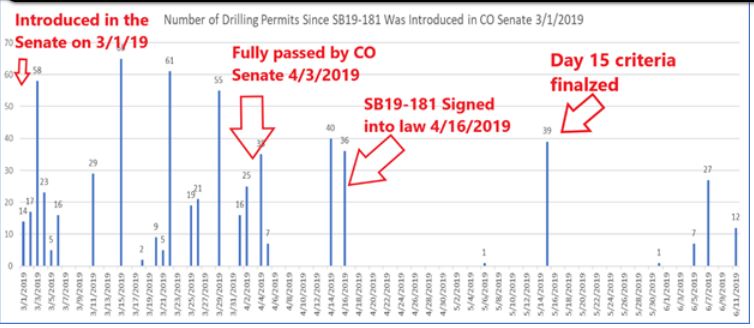
As we looked at the number and timing of drilling permits the COGCC was approving this year, our reaction was four alarm.   For example, one can see from the following chart that immediately prior to the governor signing SB 181 into law on the 16th of April, there was frenzied activity to get almost 80 drilling permits out the door, some only minutes before Governor Polis signed the bill.  These were mostly rural permits, many in Weld County.

Wells approved:
Since January 1, 2019     – 
1199
Since March 1, 2019        – 
633
Since SB181 Signed          –  87

Day 15 criteria finalized – 39

graph by Maira Orms, Be the Change

The Polis administration undoubtedly wanted to avoid delays the new law mandated, such as setback determinations to protect health and safety, continuous air monitoring, etc.  And mostly of course the governor probably wanted to keep Weld County commissioner Barbara Kirkmeyer and her four sidekicks from riding into town on their snorting steeds to properly frighten us latte-swilling city slickers and remind us that their ozone laden air was a necessary burden from Weld so that the county’s operating budget, which is dependent on the industry’s property tax payments, could survive and flourish—at least until we achieve the looming climate collapse.

But in this rush to demonstrate that all setbacks are not the same, as the governor often declares, the new administration also provided a hidden subsidy to the industry in just a couple of days of at least $20 million, for that is the difference between what the industry would have had to pay if bonding had been increased to reflect actual costs and what they pay now—a maximum of $100,000 for all wells.

Similarly, on the day Mr. Robbins finalized his “15 objective criteria” his office approved 39 new drilling permits.  His criteria are silent on bonding.  Thereby, Mr. Robbins handed the industry a $10 million subsidy on that day alone.

The following chart shows that this administration has been working overtime to get drilling permits out the door.  In fact, with about 1200 permits approved since the first of the year– This is a pace that far exceeds that of the Hickenlooper administration. Hickenlooper of course insists to this day that fracking is safe.  We can only conclude that SB 19-181 hasn’t changed much of anything in the fracking world, and will not until this administration enforces the law so as to protect the public and the planet. The bonding subsidy from 1200 permits is roughly $300 million.

Clearly, adequate bonding is a very real public welfare issue, one the new law directed the COGCC to examine through rulemaking.  The COGCC has failed out of ignorance and its desire, perhaps, to protect the interests of the industry over those of the people.  Our suggestions are as follows:

  • The minimum bonding requirement for any well must be $350,000.   This estimate is based on the actual cost of closing a few orphaned wells at public expense in the past year.  As we’ve said, each of these wells cost about $250,000 to close.  But since old wells have to be monitored and rehabbed over time—steel corrodes and cement breakdowns—we suggest the addition of $100,000 as a hedge against future maintenance costs.
  • If wells, old or new, threaten public health or the environment by their proximity to people, dedicated open space, or water resources, the costs could be upwards of $1,000,000.  Actual well closings in California and Alberta have reached these cost levels.  Bonding should reflect these realities.  This means that bonding close to people and their resources will cost substantially more, and should.
  • Any approval for sale or transfer of wells must be conditioned on the new owner assuming the bonding requirements outlined above.  Mandatory new bonding is an extremely important concept because in our opinion, and that of many financial analysts, the industry is hopelessly in debt, and likely to never recover.
  • We think the bonding should be a cash bond held in trust by the state
  • The state needs to follow Alberta’s example and determine the public’s likely liability associated with well closing and maintenance.  California, aware of the longterm fiscal threat old wells represent, passed a billthis year to assess the costs of oil and gas cleanup.  We recommend that any cleanup cost study be conducted by an independent or academic institution.
  • The quickest way to generate revenue for long-term care and closing of old wells is to increase the severance tax and establish a dedicated trust fund with the revenues.  Colorado’s severance tax rate is now has an effective .7 to .9 percent.  This is so because drillers get to deduct the property taxes they pay counties such as Weld from their severance tax obligation to the state.  The result is that in many years the oil industry in counties such as Weld pay no severance tax to the state.  In 2016 Weld collected $490 million in property taxes from the industry.  The state had to take roughly $13 million out of the general fund to keep the doors at the COGCC open.  Whatever the increased severance rate, it must be adequate to start covering the long term estimated closing and maintenance costs of wells in the oil fields, especially those of Weld County.

FINANCIAL ASSURANCE

The law now requires “thatevery operator… provide assurance that it is financially capable of fulfilling EVERY obligation imposed” by the new law, p. 19. And that the “operator demonstrate sufficient net worth to guarantee performance, and that the commission annually review the guarantee and demonstration of net worth.” p.  20.

These requirements, like the other we’ve outlined above, are in full force and effect, but like the others, the Polis administration has sidestepped them for reasons we can only guess at.

Had they not evaded these requirements of the new law, they would have learned the fracking industry is close to financial collapse.  It has lived from the day of conception on borrowed money from Wall Street and hedge funders.  Wall Street is now turning away.  Monetary institutions and insurance companies are increasingly leery of fracking as an investment.  The industry’s assets, their fossil fuel reserves, will be worthless if the leave-it-in-the- ground and international kids movements are eventually successful, as they must be if we are to avoid destroying our kind through ignorance, corruption, and greed.

The following graph shows that, even with Trump’s corporate tax cuts, the fracking industry can’t show a profit.

Their operating costs inevitably exceed their revenues.  As a result “174 North American oil and gas producers have filed for bankruptcy protection, restructuring nearly $100 billion in debt, largely through write-offs,” since 2015.  One analyst, as reported by Bethany McLean in her recent bookSaudi America, has remarked that, “The real catalyst for the shale revolution was …the 2008 financial crisis and the era of unprecedented low interest rates it ushered in.”

In Colorado the largest driller, Anadarko, has amassed, according SEC filings, over $19 billion in debt.  The new urban fracker, Extraction Oil and Gas, after only a few years of operation, has managed to amass over $1.5 billion in debt.  Overall, the frackers in the United States are at least $220 billion in debt.

SUMMARY:  It is our judgment that there is no grace period for the oil and gas industry or the Polis administration to adjust to the new law.  SB 19-181 changed the way the industry is regulated, and those changes became law on the day the governor signed the bill.   If government changes the speed limit from 60 mph to 25 mph, on a section of road because of health and safety concerns, drivers do not get a grace period to adjust.  The same should be true of the oil industry.  This will cause delays in approving permits, but the delays are necessary to satisfy the law and protect the people.  For too long the industry has had the run of the state.  A significant law was passed to make citizen health, safety, and welfare, and the protection of the environment and wildlife a condition for continued oil and gas development in this state.  As a result new life was breathed into our state constitution’s Bill of Rights which posits:

All persons have certain natural, essential and inalienable rights, among which may be reckoned the right of enjoying and defending their lives and liberties; of acquiring, possessing and protecting property; and of seeking and obtaining their safety and happiness. Art II, Sec 3, Colorado Constitution.

Be The Change files official rebuttal to the COGCC regarding the implementation of SB-181

This week, Be The Change filed an official rebuttal to COGCC chairman Jeff Robbins proposal to enact “15 objective criteria” for implementing SB-181. Below is the text of the rebuttal. You can download a PDF version of the comments here:

BEFORE THE OIL AND GAS CONSERVATION COMMISSION OF THE STATE OF COLORADO
PREHEARING STATEMENT

IN THE MATTER OF CHANGES TO     )               CAUSE NO. 1R
THE RULES AND REGULATIONS         )
OF THE OIL AND GAS                          )                DOCKET NO. 190600531
CONSERVATION COMMISSION OF   )
THE STATE OF COLORADO                 )                 TYPE: RULEMAKING

I. PREHEARING STATEMENT OF BE THE CHANGE

We repeat our comments as we have let them be known at every public forum since Mr. Robbins introduced his draft “15 objective criteria.” These “criteria” were apparently designed by Mr Robbins to be a new interim law, of his making, that will substitute for SB 181 until rules can be finalized on the actual law sometime out into the future. His estimate is up to 2 years, perhaps more. We think real rulemaking should not take 2 years, but it is likely to take longer if Mr. Robbins’ “objective criteria” continues to be the agency’s guidepost.

As we have said and will continue to say, Mr Robbins has not the authority to draft his own interim law, even if he attempts to disguise the fact by calling it “15 objective criteria.” He is acting illegally. What is more, we see nothing objective about them. They are arbitrary and capricious, in our opinion. This indeed is a sad commentary on implementation of the most important health and public protection law enacted in Colorado in at least the past decade. The ink is hardly dry, yet already the administration seems to be bowing and scraping before the oil interests in a disturbing litany of mea culpas. We hope we are proven wrong.

The apparent purpose of Robbins’ law is to allow the Director to approve new drilling permits while he discovers, after the fact, what the impacts on the public and its resources, such as air, land, and water, actually are. Mr. Robbins is being paid by the people to implement SB181 as quickly as possible, not postpone honest implementation under some fanciful notion that his job is still to protect the financial interests of the oil industry. That was the old law. The new law demands that he and his agency protect the public’s health, safety, and welfare, as well as protect wildlife and the environment. Delays in approving new drilling permits may result. They almost assuredly will since SB 181 is a sea change. It precludes new drilling permits until analysis and procedures developed through rulemaking are in place to reasonably ensure that the public’s interests and their environment are not being sacrificed.

We suggest the quickest way to satisfy the law and thereby make legal the prospect of new drilling is to base rule making on the following hierarchy:

1. Setbacks from homes, schools, and other important public resources
2. Continuous air monitoring at major facilities
3. Cumulative impacts on air, land, and water
4. Leak monitoring of pipelines and underground storage reservoirs
5. Bonding
6. Financial Assurance
7. Forced Pooling
8. Alternative site evaluation

We can see these rule making efforts taking a matter of months if honestly pursued, for some can be done rather quickly, like bonding and financial assurance rule making. We did not include interface with local governments as a rule making exercise. But the reaction in some cities such as Aurora is very disturbing. Their local government seems to think SB181 changed nothing. They believe they can proceed with permitting wells under criteria developed before 181 was passed and signed into law. Local governments need to be disabused of this belief in the strongest way possible. Delays in rule making will also allow them to catch up on their land use rights and police powers since home rule was restored to them under SB 181. The world changed with SB181, and we need to accept that as fact, and implement the law accordingly. It happened.

We have said previously that rule making on the 500 series is hopelessly out of sequence. It is way down the list of critical decisions as our rulemaking hierarchy shows. We wonder what criteria hearing officers and administrative law judges will be using when there are no rules on which to make decisions and resolve conflict. Do they make it up as they go along? Such a prospect is unfair to them and us.

Still, we agree with the Sierra Club in its call for higher penalty assessments under Series 500. We would add that refunds to offenders after they fix a leak or spill should be all but eliminated. This practice does not encourage best practices. It apologizes for mistakes. Moreover, we think a more or less hard rule should be adopted so that chronic repeat offenders lose their social license to operate in the state. Notice is thereby given to those who by their actions and inattention show disdain for our place on the planet.

Thank you for the opportunity to participate.

Phillip T Doe                                           Maria Orms
Environmental Director                       Communications Director
Be the Change                                       Be the Change

Phil Doe summarizes Colorado’s latest legislative session as ‘nothing of value’

After 5 months of doing nothing of value, although spending millions in the furtherance thereof, the Colorado legislature closed up shop last month.  The people should demand a refund for nonperformance, but instead they will have to ante up more money to pay legislators and other top state and county officials.  The wages of nothingness are great.  In 2019 the legislature will award itself a 41 percent pay increase; the governor a 39 percent increase.

Pay increases for top-of-the-pyramid public servants had already been realized in Weld County, the epicenter for the fracking wars in Colorado.  There, the county commissioners received a 37 percent increase in pay to $120,000, plus retirement and health benefits.  Later, as antidote to the red-faced disease, the salary was scaled back to $105,000, only a blushing increase of 17 percent.

The average salary of teachers in Weld is $37,000.

The generosity of Weld County taxpayers lavished on the commissioners was somewhat muted by an IRS audit to determine if the cash allowance the commissioners receive for driving to work each day should to be considered taxable income.  An estimated $500,000 has been paid out to commissioners in untaxed driving benefits over the years.  Recently, the big winner in the driving-the-old-jalopy-to-work sweepstakes was Barbara Kirkmeyer, having received $22,000 in driving dividends over the past two years.  She, once an aide to former Republican governor and Texas oilman Bill Owens, is the Dragon Lady of fracking in northern Colorado.  An early defender of fracking in neighborhoods, she has long claimed the state regs are adequate for public safety.  After all, she lectures knowingly, fracking is good for business and government budgets. 

As for the state legislature, it did manage to do one thing of note.  It mortgaged public buildings to raise almost two billion for road repairs.  The governor says it isn’t enough, but an increase in gasoline taxes or any other use fee is verboten among Republican legislators, and the Democrats continue to blame all government failures on the citizen enacted Taxpayers Bill of Rights, TABOR, which requires a vote of the people to enact a tax increase.  Oddly, the Dems claim that it is TABOR that has made them impotent, that it is a threat to representative government where elected officials should be the tax deciders, not the people legislating directly via the initiative process.  One of the leaders in the misguided and failed endeavor to overturn TABOR, Andy Kerr, is now running to replace U.S. Congressman Ed Perlmutter.  The flawlessly undistinguished Perlmutter, relentlessly climbing the greasy pole, now wants to replace the term limited Hickenlooper.  He has plenty of undistinguished company.

Of course, the mortgages on public buildings for road repairs will have to be paid back with interest, further inhibiting state budgets.  Still, the mortgage razzle dazzle was regarded by the Denver Post, the state’s flagship daily, as a grand compromise, worthy of nodding recognition.

On fracking, long the biggest and most rancorous issue in the state, nothing was done to polish that rotten apple.  Two small bills were introduced.  Both were defeated.  One would have required the mapping of all oil and gas lines in the state.  Anadarko, the state’s largest fossil fuel producer, used its well-heeled powers of persuasion on some willing Republican legislators, and defeated this extremely modest bill in the waning days of the session.  According to the Bureau of Transportation Statistics there are roughly 1.6 million miles of gas lines in the United States.   Other sources say there are 2.5 million miles of gas lines.  There is general agreement that there are about 150 thousand miles of oil lines in the nation.  In Colorado there are reportedly about 45 thousand miles of both.  However, none of these estimates include what the feds call service lines, the lines the industry uses to provide energy to its own equipment.  These service lines figure large in the following narrative. And be mindful that with the exception of interstate lines, which the feds regulate with a miniscule workforce, the intrastate lines are the bastard child in the state’s regulatory framework.  The state’s PUC seems to be marginally responsible, but as a general rule they go unregulated in a state with supposedly the “strongest oil and gas rules in the country.”

Several days after defeat of the pipeline inventory bill, in the town of Firestone, at 6312 Twilight Avenue, a house exploded killing a young man and his wife’s brother, a licensed plumber.  They had been repairing a hot water heater in the basement.  His wife, a science teacher, was critically injured.  Their young son, was less injured, if you don’t consider losing a father a form of injury.  Firestone is in Weld County.

The industry, though muffled in its response, suggested plumber error.  Almost immediately the local fire department pinned the explosion on a subterranean natural gas leak seeping into the house.  Shortly thereafter the leak was discovered to be coming from a small service line at a well owned by Anadarko, the same bunch that had squelched the legislation to inventory all pipelines only days earlier.

No explanation has ever been given as to why Anadarko didn’t notice that it was losing gas production from an open valve that bled into the small pipe that had been severed underground next to the home at 6312 Twilight Lane.  Natural gas is odorless until an odorant, called mercaptans, is added giving gas its characteristic rotten egg smell.   The vertically integrated industry makes mercaptans from other fossil fuels so that the methane heating your home smells and so that hopefully you don’t blow yourself up.

Grandstanding, Anadarko sprang into action, calling for “an abundance of caution,” it voluntarily shut down 3000 wells.  But all is not what it seems.  The wells closed down are all low producers, and in combination are responsible for an estimated 3 to 5 percent of Anadarko’s annual production in the state. The wells that people are really concerned about, the new ones with 20 to 50 wells on a pad, that can come as close as 500 feet from a residence are not part of their abundance-of-caution investigation.  The immediate hiring of Ken Salazar, the former Democratic senator from Colorado and Obama’s Secretary of Interior, as their lawyer was part of their abundance-of-caution campaign, however.

Governor Hickenlooper quickly joined in.  No longer claiming fracking was safe, at least for the moment, he vowed to get to the bottom of things.  He asked Anadarko to investigate its own accident and get back to him with recommendations.  In this regard he has asked the industry to look at all its small service pipes at old vertical well sites to ensure their integrity. Inexplicably, he too has excepted the new industrial size fracking well sites presumably under the dodgy logic that, since the accident’s source was a vertical well, it is only vertical wells that pose a threat to human life and safety. The industry is to inspect roughly 19,000 of its wells.  That leaves 30,000 active wells, another 58,000 closed and abandoned wells, and 45,00 miles of intrastate pipeline uninspected and presumed safe.

He has given the industry 60 days to get this mess behind them.  Anadaro and others have asked for an extension.  (Admission, I, as environmental director for Be the Change, a grassroots organization in Colorado, have authored three letters to Hickenlooper asking for, among other things, an independent investigation.  Reminding him that we don’t allow killers to stage their own trials, and we shouldn’t allow Anadarko to explain what they did and the risks these activities may pose to the public over the long-term, especially the risks associated with pipeline maintenance and oversight.  Eight other grassroots groups have signed on.  We have heard nothing from the governor.)

Matt Lepore, a former industry lawyer and Hickenlooper’s director of the Colorado Oil and Gas Commission, with oversight over the industry, immediately reassured people that this was an incident that had very little chance of happening again.  A few days later a contract worker was killed when a pipeline he was working on at an Anadarko storage facility exploded.  Anadarko’s stock has plummeted, and one small stockholder is suing over managerial incompetence.  Even more recently a large underground raw gas storage reservoir in sparsely populated eastern Colorado was found to be leaking.  Shades of Aliso Canyon, people were evacuated within a two-mile radius.  It got little attention in the metropolitan press, and was unremarked upon by the governor.  There are nine of these reservoirs in Colorado.  None is as big as Los Angeles’ Aliso Canyon but in total they store more.  Some are close to metropolitan areas, and people live within their boundaries, for they are nothing more than old played out gas formations.  This is raw gas that hasn’t been purified, so it is laden, as my compatriot Wendell Bradley reminds me, with compounds such as benzene.  Yes, we produce way more than we need so we rebury a lot of the poisonous stuff right under people’s backyards.  This must be perplexing to Chicago School types, for the markets can’t seem to save us from gross overproduction and reburial!

After pipelines, one of the worst loopholes in the state’s regulatory framework is the setback rule.  It doesn’t apply to developers.  It only applies to the oil industry.  Thus as Colorado continues to grow at a rapid rate, developers are free to ignore the 500 foot setbacks from residential building and 1000 feet for schools, hospitals, and high density housing.  Though neither setback has any scientific basis– it seems to be a warped utilitarian concept that killing a few at a time is better than killing many–the setback rules have provided good fodder for the industry and its apologists in government such as Weld County Commissioner Kirkmeyer, Director Lepore, and Governor Hickenlooper.

But the Firstone tragedy exposed the sham. As it turns out, the setback rules really have nothing to do with protecting human health and safety, but much to do with duplicity and deception.  The setbacks may be for drillers, but developers can build as close as 70 feet to oil facilities in many counties.  In fact, homes have been built right over old abandoned wells, many more are in streets and the backyards of new residential developments.   The governor has said he is willing to review this obscenity to fair dealing and public protection.  But review in his argot is just another word for delay as those who were forced to witness the deliberations of his Blue Ribbon panel on fracking, of a couple of years ago, can attest.

The stench of corruption and contempt for the people who are in the crosshairs of the urban drillers is so pervasive in this state that many have lost their sense of smell.  This is not an unknown phenomenon in nature or social structure.  Hydrogen Sulfide is a deadly gas that has an acrid smell as early warning, but as a broad spectrum poison it quickly deadens the senses, including the sense of smell, to mask its deadly potential.

Similarly, in Silent Spill, the author, Thomas Beamish, records how the largest oil spill prior to Deepwater Horizon went uncontrolled for years. It occurred at an Occidental Oil refinery along the coast of California, north of LA, at a place called Guadalupe Dunes.  It endured for 39 years. Oil refining was a big part of the local economy, so, as Ibsen could explain, looking the other way could be expected, especially from local politicians and people and businesses dependent on the refinery.  But since it was not a dramatic event like the Exxon Valdes, the people in charge were basically allowed to ignore the devastation and the local population became inured to what was happening to their environment on a day-to-day basis.

The Firestone tragedy was dramatic, no silent spill it. Clearly, Firestone has resulted in national attention and has raised awareness of the suffering people in the sights of the industry, greedy developers, and a complicit and thuggish government must endure.

A recent court decision will add to the drama.  The Colorado Court of Appeals ruled for the kids when they challenged the COGCC regulations as not protective of their right to a livable environment, Martinez v COGCC.

The COGCC had argued that its mission was dual—to protect human health and the environment 50 percent of the time and encourage oil and gas development the other 50 percent of the time.  They actually got a pliant lawyer from of the Attorney General’s office to make this argument in court.  I witnessed it, and he seemed not to be embarrassed by the absurdity of his assertion.   Thus intellectually equipped, he might just as easily have argued that the fire department’s job is to put out fires 50 percent of the time, and start them the other 50 percent.

The kids had asked for “a rule to suspend the issuance of permits that allow hydraulic fracturing until it can be done without adversely impacting human health and safety and without impairing Colorado’s atmospheric resource and climate system, water, soil, wildlife, other biological resources.”

The Court reminded the COGCC that its own website supported the kids’ request and, that the law itself did not support its contention: “The plain meaning of the statutory language indicates that fostering balanced, nonwasteful development is in the public interest when that development is completed subject to the

protection of public health, safety, and welfare. See  § 34-60-102(1)(a)(I); see also Gerrity Oil & Gas Corp., 946 P.2d at

925.”

Cagily, Hicenlooper said he would not contest the decision, but he did not go so far as to direct the COGCC to start rulemaking as the court had directed.  Instead he allowed the COGCC, an agency within his executive branch, all of whose members he had appointed, to ask for an appeal to the state supreme court.  This gave the state’s Attorney General, Cynthia Coffman, the wife of Republican U.S. Congressman Mike Coffman, a state client, though she may not have needed it since she had already taken it upon herself, using taxpayer money, of course, to sue Boulder County on behalf of the oil industry over its oil and gas regulations, or lack thereof.  She, too, is reportedly considering a run for governor.

In a sense Hickenlooper had created a constitutional crisis by giving his authority as the state’s chief executive over to the state’s oil-industry fawning attorney general.  Some have argued this outcome was predictable because it is the oil industry that is in charge in this state and has been for a very long time.  The actions of the Governor and the AG tend to confirm that assessment.

The drama surrounding the COGCC decision is revealing.  The commission, according to its chairman, voted unanimously in favor of referring the appellate decision to the high court.  That assertion was later contradicted by Dr Larry Wolk, the state’s head of public health and COGCC board member.  He claims he abstained, but he may have been channeling the recent court decision in Michigan.  There, the director of the Michigan’s Department of Public Health and Human Services has been charged with involuntary manslaughter and misconduct in Flint’s drinking water crisis. The state’s chief medical officer has been charged with obstruction of justice.

That the COGCC and the Governor never had any intention to abide by the Appeals Court directive to go into rule making to protect human health and the environment should be clear.  For not long after the Firestone explosion, and after saying a few words of attonement over the tragedy, the COGCC quickly went to work approving drilling permits.

As for the Appeals court decision it didn’t take the Denver Post long to come down on the kids.  They were the unwilling dupes of rabid environmentalist intoned the Post.  This is a paper owned by a Wall Street hedge fund that has savaged the reporting staff in the interests of the bottom line.  The CEO is Mac Tully.  He is a proud member of Colorado Concern, the by-invitation-only organization of CEO’s who insist they know how the state should be run.  It is resplendent with oil executives, and was the guiding force behind Initiative 71, which effectively repealed the people’s right to write law by means of the initiative.

It’s hard to see any light through this impenetrable morass of bad government serving the interests of dictatorial corporate control. Can revolt be far behind?

Be The Change Writes Third Response to the Firestone Explosion

Dear Governor Hickenlooper:

Following the Firestone tragedy in which two young men were killed, a young son was left without a father, and his mother, the wife of one of the men, was seriously injured, we asked that you establish an independent committee to investigate the causes of that gas explosion and determine the risks of recurrence.

We made that request in two letters dated May 2 and 3, 2017.  They are attached for your reacquaintance.  We have had no reply.  Indeed, it appears you are still committed to allowing the industry to investigate and judge its own accident.

In this nation, industrial accidents are investigated by independent government entities to determine their cause and any corrective action needed to protect the public.  Negligence is not ruled out as a contributing factor until all the facts are known.  That approach needs to be adopted in this case.  You must abandon your hands off, “business friendly” regulatory approach.  The facts demand it.

Indeed, we question the adequacy of Anadarko Petroleum closing down 3000 vertical wells, most of which are low producing wells, since the shut downs result in only a 3 percent loss in overall oil and gas production for the company.  This “abundance of caution,” as they term it, smacks a little of the wolf in granny’s clothes.  They would have us believe that the problem is with old vertical wells, when in fact, the new, industrial-size, horizontal wells, 10 to 40 wells on a pad, pose an even greater threat to public safety, in our estimation.  Size matters, and all wells grow old and eventually leak, as even the industry admits.  In our opinion, all operations, old and new, and not just pipelines from old wells, need to be independently evaluated.  The issues are gas leakage, pipeline alignment and maintenance, and well proximity to humans.  All must be independently evaluated for the risks they pose to the public, especially those living close to the industry’s infrastructure, i.e., wells, pipelines, and storage facilities.

We would remind you that Anadarko’s record in these matters is deplorable.  In 2015, for example, the company was fined $5.15 billion in federal bankruptcy court for attempting to escape cleanup costs for major environmental damage done by one of its subsidiaries, Kerr-McGee.  The prosecuting attorney in that case was Preet Bharara, the US Attorney for the Southern District of New York.

Known as the “Sheriff of Wall Street,” Bharara was recently fired by Donald Trump after being assured earlier that he could stay on.  He has asked for an independent investigation of Trump’s Russian imbroglio to help restore confidence in government.  The latest polls show that almost 60 percent of American citizens agree with him.  Politicians in your party have been particularly keen on an independent investigation.  And indeed the public pressure finally won out.  Last week an independent investigator was appointed by Congress to investigate suspicions concerning Trump’s relationship with Russia and Vladimir Putin.

You need to take this example to heart.  Transparency must inform this investigation, and thoroughness must be its hallmark.  A 30-day look about by the industry at its old vertical wells and flow lines, as you suggest, will not do it.

Moreover, the COGCC’s recent vote to contest the Court of Appeals ruling that the agency’s first and primary obligation is not the development of oil and gas, as it contends, but the protection of public health and the environment, leaves us incredulous.  Are you the Governor of this state or is Attorney General Cynthia Coffman?  You said publicly that you did not want that decision contested.  By allowing the COGCC, an agency under your control, to ignore your expressed policy decision to implement the court’s recommendations, are you not creating a constitutional crisis?  Are you not, by inaction, abdicating the executive branch to Ms Coffman and the oil industry?

One thing is for sure, the rogue actions of the COGCC and its executive director, Matt Lepore, must be addressed.  Dr. Larry Wolk, the state’s demonstrably weak chief medical officer, who as board member on the oil and gas commission voted to contest rather than protect public health, is a special case. You appointed them all.  Forced resignations and terminations are in order.

Quite frankly governor, as we’ve said before, the COGCC’s formulation that it had the obligation to promote oil and gas development 50 percent of the time and protect public health the environment other 50 percent is an absurd and infantile formulation, one devoid of all logic.  Even more embarrassing is the fact that the Court of Appeals had to remind your agency what was in its own published guidelines.  Those guidelines declare the agency’s first obligation to be the protection of public health and the environment.  There is nothing to contest, but there is much to correct.

We are aware that the federal National Transportation Safety Board will be looking at the Firestone pipeline explosion, for pipelines are considered a mode of transportation for oil and gas.  But this examination, while potentially helpful, will be limited in scope.  Moreover, NTSB’s investigation cannot substitute for your constitutional obligation as recited in your oath of office to protect the public’s health and safety.  That promise and obligation can only be fulfilled with an open and full investigation of the risks to people living near oil and gas development.

For these reasons and others, we the citizens and organizations listed below ask for a thorough independent investigation, for only then can public confidence in government be restored.

Be The Change

Phillip Doe, Environmental Director

Colorado Rising

Wall of Women Colorado

Jews Of The Earth

350 Colorado

Lakewood Fracktivists

Food and Water Watch

North Metro Neighbors for Safe Energy

WildEarth Guardians

Metro Denver Community Rights

What the Frack?! Arapahoe

Douglas County Greens

The Question Alliance

Our Health, Our Future, Our Longmont

PROTECT OUR LOVELAND

Loretto Earth Network

Fractivist.org

Be The Change Writes Second Response to the Firestone Explosion

Photo from One News Page

Subject: Second request for an independent investigation of the causes of the Firestone explosion and the risks of reoccurrence 
5/3/2017

Dear Governor:

We appreciate that you are taking the risks associated with the Firestone explosion seriously.  And while we are loath to play the dog in the manger, we think your response as presented in the Denver Post has weaknesses borne of your need to respond to the public outcry in a timely manner.

We again request, as in our original letter of 2 days ago, an independent investigation.  We think the public’s interest can only be served in this way, with an independent investigative panel empowered to hold hearings and gather information free of any outside influences.

Government’s first and primary function, as you know, is to protect public health and safety. That responsibility cannot be shunted off to the oil and gas industry. Such a regulatory formulation, given the circumstances at hand, is unacceptable.  Indeed, in our opinion, oil and gas’s control of the playing field contributed to this disaster, and we are not convinced that their economic interests will allow them to be disinterested investigators.  In fact, the concept is laughable.  Think of Upton Sinclair’s expose of the meat packing industry in The Jungle as instructive.
Thus, our recommendations are as follows:

It seems highly unlikely that Anadarko, with its after-the-fact claim to be closing its lines out of an “abundance of caution,” can be relied upon to clean up what some observers believe is an Augean mess.  For instance, we do not understand why Anadarko would not have analyzed the reasons for production shortfall and taken corrective steps if gas production was below anticipated or historical levels when the Firestone well was reopened.  If any reasonable analysis were undertaken, wouldn’t they have discovered the open valve to the old line they somehow forgot(?) to close?

Our citizen experts think it was more likely a problem with the cement-on-steel seal–an integral part of every well construction that chronically fails over time and for which no solution exists.  How a leaky well seal, a commonplace, especially on older wells, and an open valve to an abandoned line may have intersected in creating the tragedy is unknown, but should be investigated thoroughly. This odd and suspicious coincidence, combined with the chronic well seal problem, should cause any reasonable person to ask how many wells are there out there that have closed off or abandoned lines, and how safe are the seals and valves at the wells that close off those old lines?  Indeed, how safe are the seals and valves at wells to working lines?  What is the life expectancy of well seals and valves? What are industry SOPs on inspection and replacement? We cannot and should not let the industry answer these questions absent independent public oversight.

There are other open questions as well, but this is front and center at the moment given what has been reported in the press. Corrosion of old lines also worries us.  What protections are in place to insure that old lines, thought to be steel, are still safe? And what is the life expectancy of the steel lines and the newer plastic lines?   And of course there is the overarching question of when is the state going to address the total lack of inspection of gathering lines and transport lines, of which there are many thousands of miles?  It shakes our confidence further when the COGCC’s Director Matt Lepore tells us they don’t have good information on the location, age, and disposition of oil and gas supply lines in the field.

I don’t think it is wild eyed to suspect either a cover up to keep wells working or something approaching criminal negligence.  This rush to final judgment without hearings in which technical experts can add to the fire department’s assessment is unseemly.  Moreover, Matt Lapore’s assurance another incident is unlikely to occur doesn’t carry weight.  He is a lawyer, not an expert, engineer, or scientist with deep technical knowledge.

The ringing question is still, what is the risk this incident exposed, what holes did this incident expose in the state’s regulatory framework, especially with regard to seal, valve, and pipeline inspection and safety, and what standards are used or should be used to assess risk?  The public in fracked cities and communities, from experience, have no confidence in the COGCC or Director Lepore.

Government has to take this lack of confidence seriously.   After all, government’s first constitutional duty, as we said at the outset, is to assure the public’s health and safety.  Until an independent risk assessment is made, and independent experts can review the information and the decision process, it will continue to look and smell like a quick burial of public concern, coinciding with the burial of the two young men killed tragically by an incident that government assures us is unlikely to reoccur.  We are not persuaded, and with good reason.

Finally, we welcome your understanding that there is a giant loophole in the state regulations regarding developers.  The oil and gas industry, without a request for variance, which can be granted, must observe setbacks of 500 feet from homes and 1000 feet from schools, hospitals, and some other high occupancy buildings.  Yet this standard is not applied to developers.  Forget for the moment, as the COGCC recognizes, there is no scientific evidence to support the present industry setbacks–they are simply cosmetic and in response to public alarm–how can the state look the other way in allowing setbacks of only a 150 feet for developers in some instances, and maybe none at all, in others? In fact, our intelligence is that some houses have been built over old abandoned wells and gathering lines.

Is the issue here public safety and the protection thereof, or is government trying to placate the developers at the same time it is playing a different placating game with the oil industry and yet another placating game with homeowners, city and county governments, and others sitting on top of various oil and gas infrastructure??  Your promise that the state will look at this loophole is not convincing.  If the 500 and 1000-foot setbacks are minimums for the oil industry, how can they be any different for the developers?  That loophole should be closed without delay if indeed it is the public’s health and safety we are interested in.

Thanks you for your attention, and we look forward to your reply,

Phillip Doe
Environmental Director
Be the Change